CooperDrive: Enhancing Driving Decisions Through Cooperative Perception
Toyota Motor North America, InfoTech Labs
Real-Vehicle Demo
Real-world closed-loop deployment of CooperDrive in occlusion-heavy and non-line-of-sight intersection scenarios. Compared with ego-only perception, cooperative perception enables earlier hazard awareness and safer path planning decisions.
Method
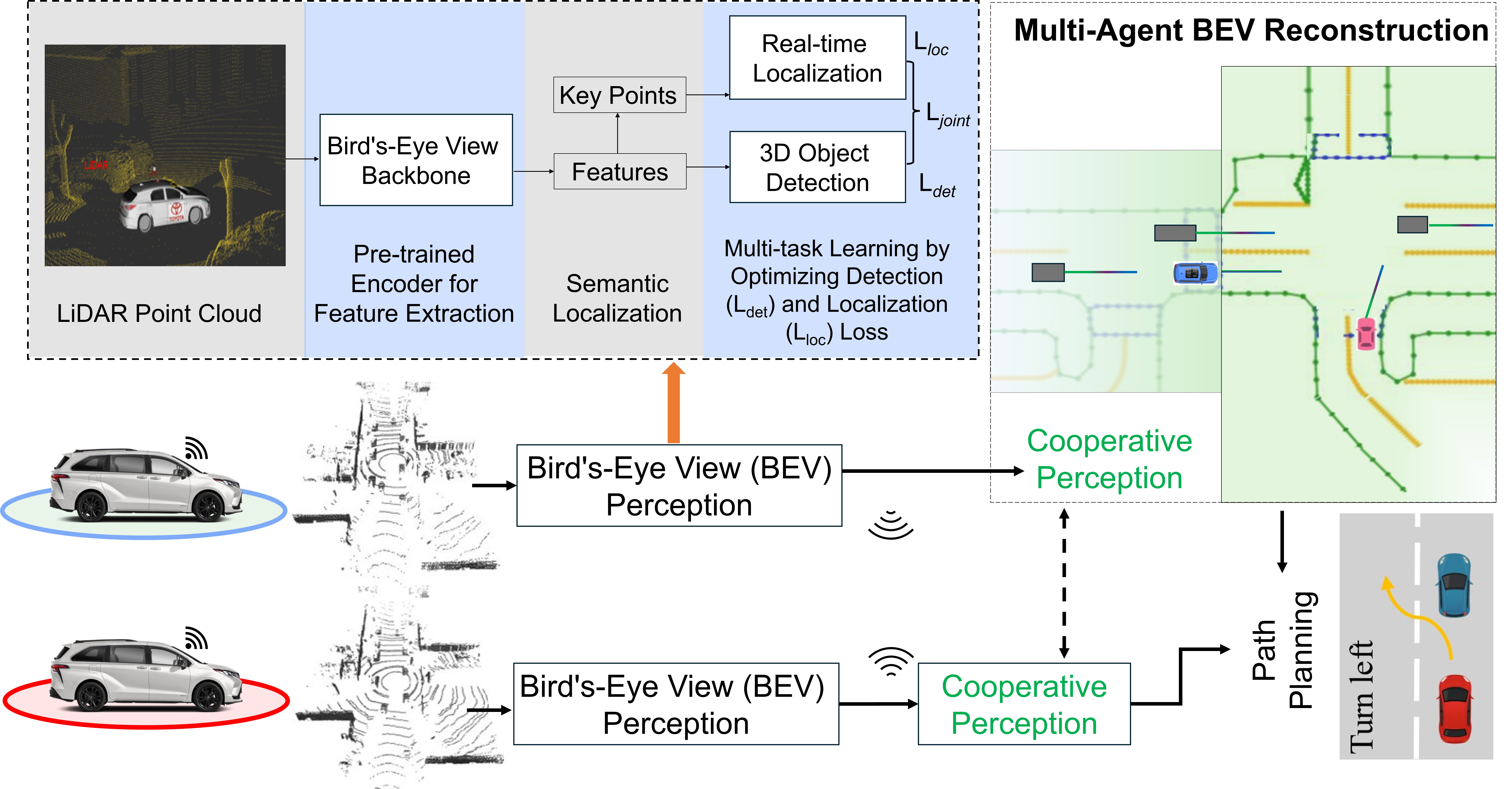
Reconstructed Bird’s-Eye View (BEV) representation generated through cooperative perception, where each vehicle contributes precise localization and detection outputs from our proposed Multi-task BEV Perception Network to enhance situational awareness and support safer path planning.
Highlights
Multi-task BEV perception
A shared BEV backbone jointly supports 3D object detection and localization in one efficient perception pipeline.
Lightweight object-level sharing
CooperDrive exchanges compact object-level results instead of raw sensor data or BEV features, making communication practical for real vehicles.
Planning-aware benefit
Cooperative perception directly improves downstream planning by revealing occluded hazards earlier, without changing the existing planner architecture.
Real-world validation
The framework is validated through real-vehicle closed-loop tests in occlusion-heavy and NLOS intersections, demonstrating practical safety gains under strict communication constraints.
Planning Results
| Method | TTCmin (s) ↑ | DRAC (m/s²) ↓ | DCZ (m) ↑ | VR (%) ↓ |
|---|---|---|---|---|
| Ego-only | 2.05 | 0.312 | 2.01 | 18 |
| CooperDrive | 6.62 | 0.060 | 4.12 | 2 |
| Improvement | +4.57 | -0.252 | +2.11 | -16 |
Across all tested scenarios, cooperative perception improves safety margin and enables earlier, less aggressive planning maneuvers.
Metric definitions.
- Minimum Time-to-Collision (TTCmin): shortest predicted time to a potential collision.
- Deceleration Rate to Avoid Crash (DRAC): minimum deceleration required to avoid a crash.
- Distance to Conflict Zone (DCZ): shortest distance to a predicted conflict zone.
- Violation Rate (VR): percentage of planning steps that violate safety constraints.
BibTeX
If you find CooperDrive useful in your research, please consider citing our paper:
@article{qu2026cooperdrive,
  title={CooperDrive: Enhancing Driving Decisions Through Cooperative Perception},
  author={Qu, Deyuan and Chen, Qi and Shimizu, Takayuki and Altintas, Onur},
  journal={arXiv preprint arXiv:2604.14454},
  year={2026}
}